The machine shop finished making us nice cylinders, to which we applied all those strain gauges and wires. Check out that pretty copper-colored patina on the outside. That comes from a successful heat treatment, which locks in the desired hardness. Our old ones didn't have this patina, which may be one indication of why they crapped out on us. We also had the shop make us some hemispherical seats for the load cells. The piece attached directly to the piston has a convex surface and the large visible partner piece has a concave surface. That way, when you apply the load any small deviations in alignment are worked out. Above is a our vertical load cell and below is the horizontal, which applies the normal stress.
text
The rock and ice mechanics lab at Lamont-Doherty is led by PIs Christine McCarthy and Ben Holtzman. Now, more than ever, we are in the process of growing our lab and building our experimental program. Along with a team of postdocs, undergrads, grads, techs, and longtime staff engineer Ted, we are rehabilitating and revamping some of the old equipment and building and buying new rigs for exciting new experiments on both rock and ice. You can follow along with our progress here.
Sunday, 5 February 2012
Friday, 13 January 2012
Hear-Here: a trip into the past
This week we made a trip to the machine shop on the other side of campus. It was my first time going and was I in for a treat. The purpose of the visit was to place an order with the shop to build us some new load cells and hemispherically seated pistons. We were getting quirky signals from our load cells and suspected that they had been overloaded and damaged. To test our suspicion we popped one into the Rockwell hardness tester to the right. We first had to try a bunch of standards, since we weren't entirely sure the tester still worked. But after getting consistent values with the known standards, we measured our load cell. Yikes! It was far softer than it should be. Poor baby was broken. Good thing the shop was available to start on some new cylinders. We'll add the strain gauges and wiring to them next week.
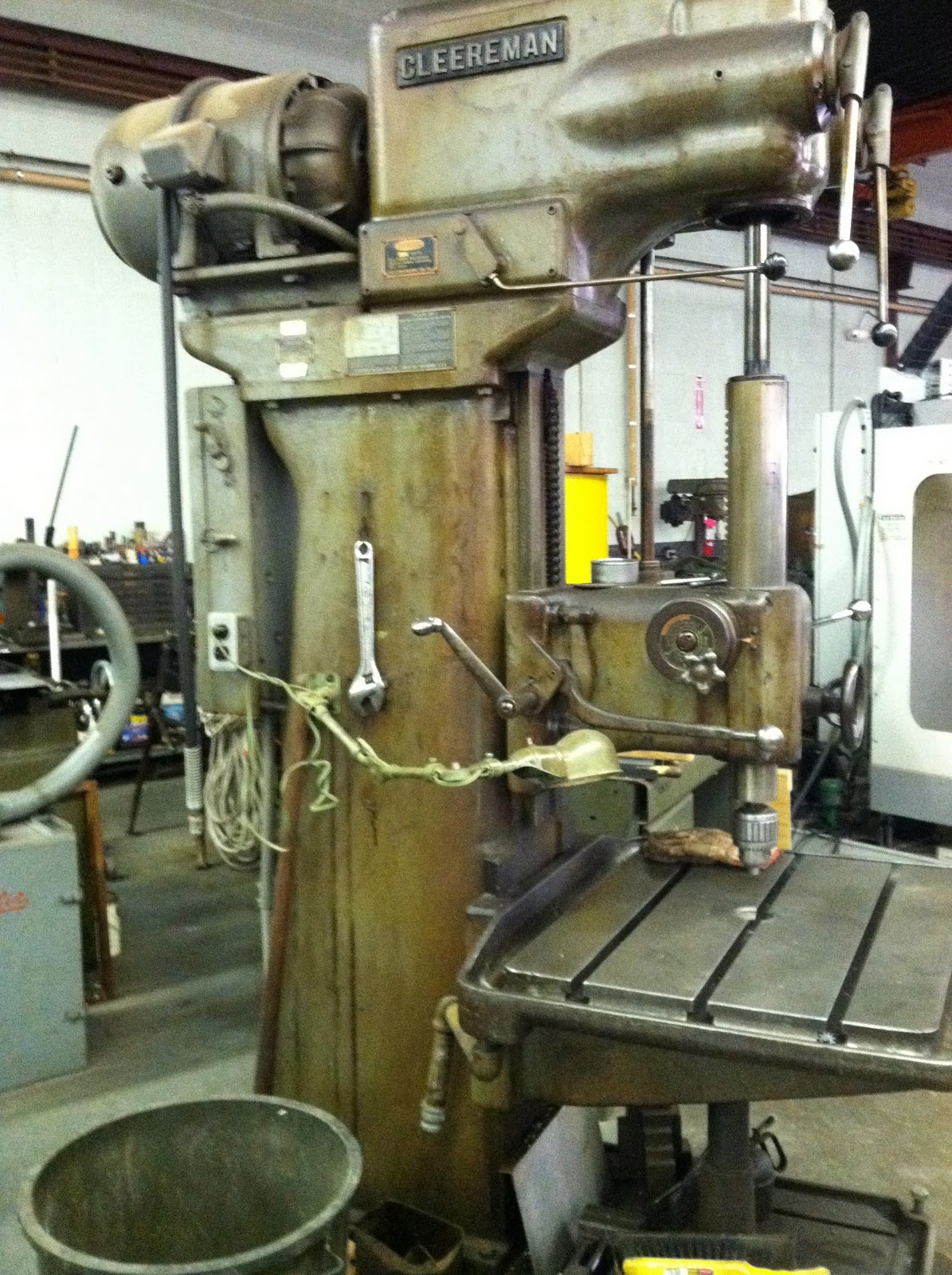
While we were over there we started poking around at some of the old machines. Check out these ancient drill presses. I think they still actually work.
But this dirty little phone booth station in the middle of the shop was my favorite. When exactly those notes on the back wall were written probably nobody knows, but I bet they contain every important phone number in the NY and NJ area codes. I wouldn't throw them out either. Some things you just don't mess with.
Like the Hear-Here.
Monday, 19 December 2011
(mini-) Earthquake!
Ladies and gentlemen, the Biax is now fully operational! We can now make earthquakes in our lab!
The main cause for the delay was this pesky guy below. The chassis is the component that handles the flow of all that data coming from the rig (10 strain gauges, 2 load cells, an LVDT measuring displacement, and anywhere from 1 to 4 transducers measuring the seismic signal) and going to the computer (for immediate feedback) and to the RAID (for short-term storage). Although the data all come in as basic voltage signals, the rate of data streaming for the different components varies, making it difficult, for some reason, to get the optimal combination of cards and cords for the chassis. While I was away, Heather worked with the manufacturer to get us the right combination. The card on the far left gets the signal from the BNC, the card protruding gets the high speed signal from the transducers, and the wide middle card is a built-in RAID.
It took a little while to get here, but we now are able to load up the sample and, by monitoring the voltage on the LVDT, watch it creep along until we hear the "Crack" and "Pop" of little earthquakes. Success! Now we get to start systematically varying things to be able to predict the onset of the earthquakes and, in particular, try to understand the transitional period that is believed to occur between the creeping and the earthquake.
Friday, 2 December 2011
soldering up a storm
Now, in order for the confining pressure and pore fluid pressure intensifiers to respond and "stop on a dime", if you will, the hydraulics have to have something to push against. So we needed to rig up pipes that will carry compressed air from the air compressor in the room next door. In addition, there needs to be a reservoir of air on the ready in case a large volume is needed. Thus the big yellow buoy-looking thing on the left. So, armed with about 50 feet of 3/4" copper tubing, tube cutters, miscellaneous tees and elbows, solder, and a blowtorch (!!), we got to work.
Often times that meant one of us jumping up on top of the rig itself and soldering into the existing pipes in the wall/ceiling. This was my first time soldering pipes, so I can't say I was very meticulous at the job. I road home on the subway just filthy, completely covered with a thin layer of hydraulic fluid and probably bits of wall insulation and flux. But I have to say, it was pretty darn fun!
Check out our handiwork below.
Wednesday, 30 November 2011
"Triax this is Houston, do you read?"
Ted and Heather got a lot of work done on the Triaxial apparatus while I was away. For one thing, they got the pressure vessel all lined up and then set up these two blue mini-versions of the vessel, called intensifiers, that control the confining pressure and the pore fluid pressure (so, one controls the pressure outside the sample and the other, inside). We'll use kerosene for the confining liquid. There's also that row of seven things sitting atop the mini-vessels. I don't know what they do yet but I'm excited to find out.
In addition, there are now big hoses going to and from the vessel and intensifiers and a burly hydraulic fluid pump. The pump is so powerful and loud that it sits in its own insulated doghouse outside the lab, otherwise it would drive us all crazy.
And one very exciting development is that they rewired the old control panel that will be used to communicate with the Triax. Since the rig will get up to very high pressures during experiments, you really don't want to be standing next to it while it is running. Rather, you want to be safely around the corner at this groovy old school station, complete with analogue Heise pressure gauges (on the blue wall panel) and all the digital readings you require.
Thursday, 24 November 2011
Research Trip: Edinburgh
For the last 30 days I was in Edinburgh on a research exchange visit. It was an absolutely wonderful time to be visiting Scotland. The days were brisk, but not that cold and somehow I managed to avoid most of the rain.
The visit was funded by a branch of the European Science Foundation, called MicroDICE. Their purpose is to promote the exchange of science and techniques between Universities and countries, especially if it is concerning the microstructures of Ice.
I was visiting Jane Blackford, who is in the Materials Science department of the University of Edinburgh. Here's Jane with the fields of outer Edinburgh below her. Whenever we weren't in the lab, we tried to sneak out to the surrounding hills for a hike or to the local climbing gym for a route or two.
Our research goal was to measure the "dihedral angle" of sulfuric acid and ice, that is, the wetting angle that a liquid acid solution makes in the corners of ice grains, which is determined by the surface energies. Sulfuric acid has been found in polar ice packs and is thought to exist on icy moons in the outer solar system. The reason for measuring the angle is because if the angle is very large (>60 degrees), sulfuric acid would be stuck and confined to the corners of grains, but if the angle is small (<60 degrees) it could travel through interconnected veins of liquid. Traveling liquid acid could really influence the physical properties of ice, so it is an important characteristic to measure. We sprayed a solution of ~5%acid into liquid nitrogen so that it would flash freeze into droplets that we collected and put into these little aluminum containers (right). Then we let the samples "cook" at various temperatures that were below the freezing temperature of ice yet above the freezing temperature for the liquid acid solution. We let them sit like that for about a week and then we quenched them in liquid nitrogen to capture that microstructure. Then it was off to the Biology department to visit Chris Jeffree and his scanning electron microscope that is specially equipped to handle frozen samples (below).
Chris was an absolute wizard with the SEM and managed to take hundreds of images of dihedral angles. I am now in the process of measuring all those angles, first by hand and then electronically. Publication coming soon!
Monday, 17 October 2011
working on the triax
Now that the biaxial apparatus is ready to run (we're just hammering out some bugs with our National Instrument gear), our attention has turned to the triaxial rig. It applies a confining pressure using either gas or a solid medium. The pressure inside the vessel can really build and if it blows, it could be deadly, so this behemoth sits in its own room in the back of the lab. Our first task was to rotate the steel cylindrical vessel 90 degrees so that it can connect to new gas tubing and then check the integrity and alignment of the vessel. The vessel and attached top plate together weigh almost 1000 lbs, so taking things apart is no small feat. Ted rigged up a pulley system to a beam in the ceiling and we carefully lowered the two parts, which immediately began to swing out on us.
Eventually we got the parts under control, rotated, and back up in place. Next week while I am away, Ted and Heather will make sure the vessel is perfectly centered. They will use a tool that precisely measures the location of the inside wall of the vessel with a needle. Using the machine hydraulics they will raise the needle up the inner length of the vessel. If there is any tilt to the vessel wall, the tool will indicate that and they can shove little wedges of wood or thin steel around the top plate to center it.
Subscribe to:
Posts (Atom)