text

The rock and ice mechanics lab at Lamont-Doherty is led by PIs Christine McCarthy and Ben Holtzman. Now, more than ever, we are in the process of growing our lab and building our experimental program. Along with a team of postdocs, undergrads, grads, techs, and longtime staff engineer Ted, we are rehabilitating and revamping some of the old equipment and building and buying new rigs for exciting new experiments on both rock and ice. You can follow along with our progress here.

Wednesday, 21 November 2012

Oh Mandy, Well you visited and you helped get the triax running...

Just like Barry Manilow, we are singing the praises of our visiting scientist, Mandy Duda. She came to Lamont this fall to run some experiments on the triaxial deformation apparatus. Her visit is funded by a postdoc fellowship from the German funding agency, DAAD. Her plan is to do some cyclical loading of rock samples, under confining pressure at various temperatures. But before she could start getting some data, she and Ted had a lot of work to do. A new burly intensifier to control confining pressure was added and connected to the hydraulic plumbing system (below left) and a Haskel air booster was wired up to help apply the confining pressure (below right).

After a lot of troubleshooting, she is now able to load her samples. Here she has wrapped her Westerly granite samples with copper tubing and is attaching it to the top closure nut. The blue stuff is rubber tubing that seals the interface between the sample and the end caps. Wires coming out the bottom (top) of the closure nut (which will be inverted when the sample is loaded) will send the temperature measurements to the command center and the computer. 
Sample is all loaded. Now she's just checking to see if things are aligned. She also connects the LVDT which will measure vertical displacement of the bottom piston.
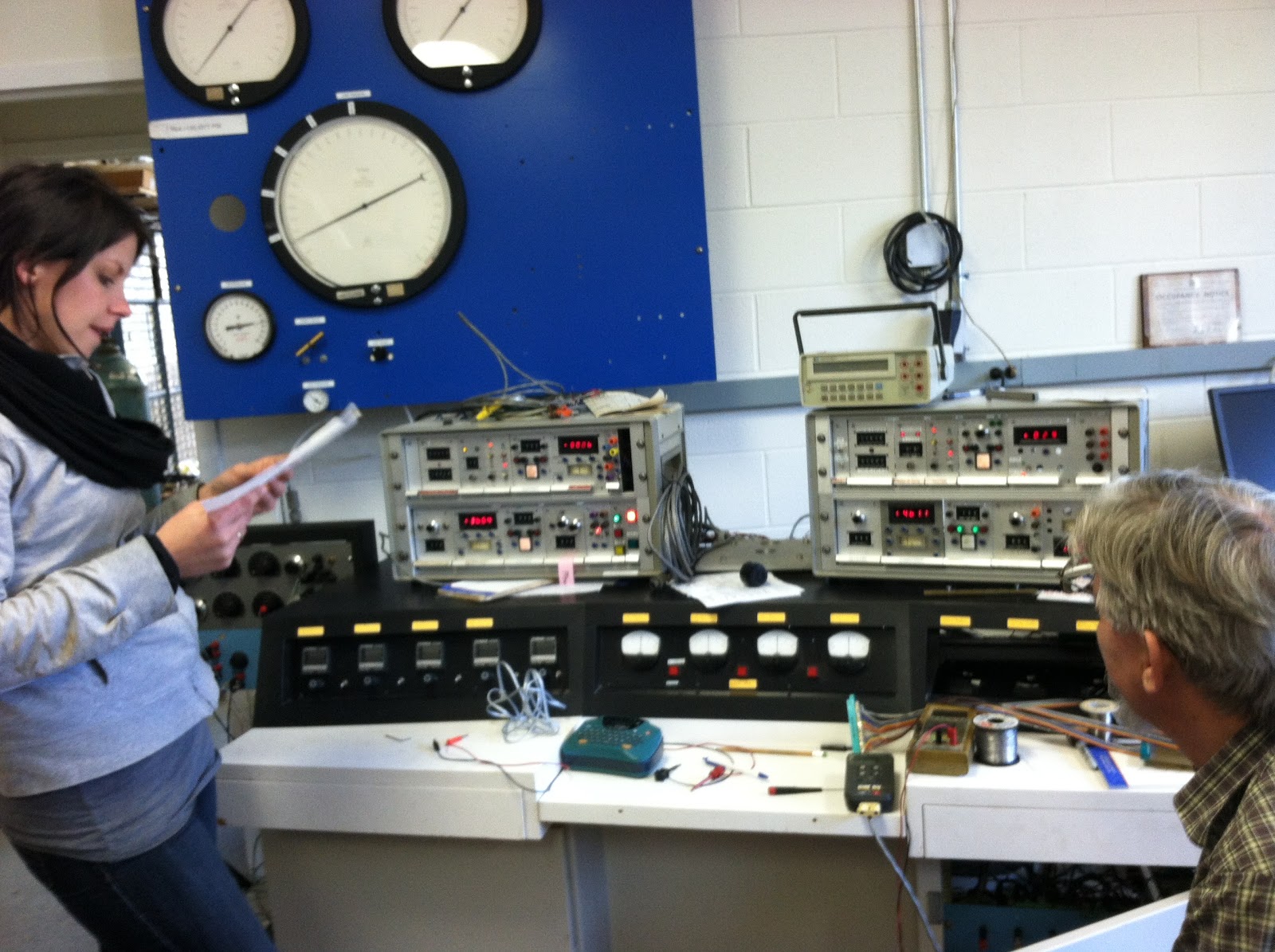
It's go time! Here Mandy and Ted are at the command center applying a confining pressure to the sample for the first time. The rig has no trouble going up to and holding pressure at 60 MPa. Success! Next they will try to apply a vertical load to a sample, in addition to the confining pressure. Can't wait to see the results of her cyclic loading experiments!
Monday, 20 August 2012

design work on the road

At the experimentalist's workshop, Ted and I tinkered with the design for the ice rig. While I scribbled around on graphing paper, Ted transferred my ideas to a digital CAD-style schematic and fine-tuned the bottom loading feature. It's coming along...

Friday, 17 August 2012

old Dutch lathe

Ted, Heather, and I are off in Boston at a workshop for experimentalists, so there's not a lot of progress in the lab at the moment. In the meantime I thought I'd share some pictures taken during my vacation in the Netherlands last week. In a small town near Amsterdam there is an open-air museum called Zuiderzee, which is an entire 17th century Dutch fishing village. In addition to all kinds of other aspects related to life at that time (smoking fish, doing laundry, burning coal, rope-making, etc.) the museum had a guy doing some woodworking using an old-school, foot-powered lathe. It looked pretty fun.

I suppose once you do some woodworking to make your wooden shoe, you could grab some paint and glitter and "Pimp your klomp"!

Friday, 13 July 2012

Summer at Lamont

Summer at Lamont is a glorious thing. No classes, no reading groups, no seminars. It's all just about research and finding ways to enjoy the sun. This year a bunch of us kicked off the summer with the First Annual Crawfish boil. Tim (below, aproned) spent some time in the Big Easy, so he knows how it should all go down. He flew in an ungodly amount of live craw daddies from Louisiana (seriously, he picked them up at the airport and everything!) brought potatoes, corn, andouille, some secret spices, and pots big enough to feed an army. While we looked on and cheered, he boiled the whole thing up. 

The feast was spread out on a newspaper and we all devoured it with nothing but our hands. So tasty!

One of the great things about Lamont is the wild life. Even though we're only a half hour from Manhattan, we're essentially in the woods here. Pretty much year round we have regular sightings of deer, wild turkeys, squirrels, and bunnies. With the onset of spring and summer, we also start to see baby things. All summer we've been watching this pair of geese and their pack of goslings right outside our office window.
Well they ate and they ate and now, mid-summer, they are all grown up! (They also have a very unhealthy confidence around humans and get VERY close to us. This was not taken with a zoom lens)
 Okay, this is the world's worst camera phone picture but I was just so excited to see yet another animal on campus: a little turtle making its way over to the small lake we have on campus.

Summer is also the time for campus construction. Here a huge crane is being used to make improvements to the core lab. We are also having the second floor of the seismology building completely renovated. I can hear the lovely cacophony of saws and sledgehammers right now actually. (Okay so there is some downside to the summer activities. But we'll get lots of new, much-needed office space, so it's worth it). Next to the core lab some folks have also started a new Lamont community garden. Volunteers have pitched in to put up a new fence with chicken wire to keep out the gophers and, below, are busy tilling and planting.
And during the summer everyone gets out to enjoy their sport of choice. The soccer players have a regular crew of folks come out on Mondays, Wednesdays, and Fridays at lunch. Just beyond their field, you'll see volleyball net up for the ballers who play on Tuesdays and Thursdays at 1:00. There is even yoga on Tuesdays in the old Lamont hall library. I have been trying to get a regular ultimate frisbee game going as well, but we are having a hard time getting a consistent group together with everyone's summer travel schedules. I'll keep trying to rally the troops.

Speaking of travel schedules, Ted should be coming back soon from his research cruise. Before Heather and I take off for our conferences, I hope we will all be able to make some big progress on the ice rig. So more on that soon!

Friday, 6 July 2012

Erector set fun

Today's big accomplishment in the lab was that I made the frame upon which the ice rig will sit. The facilities folks brought over some bars and I used the green unistrut fittings leftover from the renovation to hold it together. I never had an erector set growing up, but I imagine it was quite a bit like this...that is, incredibly fun! I still have to make sure things are level, tighten all the bolts, and affix the base plates to the dock, but it is getting pretty close. The ultimate test will be whether it can hold 300-400 lbs of rig on top of it without toppling over on me. Fingers crossed.

Tuesday, 3 July 2012

more panels

So now that the thermocouples have all been wired up, it is time to move on to the other forms of feedback that my cryo-friction rig will receive. Since we will be applying a biaxial load, we will need at least two load cells. We've decided to actually use three load cells (two horizontally and one vertically) so that we can be sure the normal load is consistent across the horizontal pistons (see here for schematic). In order to take the voltage signal from the load cell to the computer (and to display the current values), we need these type of card+meter panels. We salvaged a couple from old rigs but that plexiglass one is broken (and doesn't match...tacky!) and needs to be replaced.

There are companies that sell the perfect size of aluminum front plates with holes in all the right places, but they want ~$30 a pop for them. Money is a bit tight here in the ice research program, so I decided I would instead cut down my own aluminum panels from some other sheets we had on hand. First I cut down the length (though shown below in the milling machine, I actually used the saw) and then put the plate in the milling machine to make the square hole for the meter and small holes for screws. Those rounded edges on my square are the sign of a very poor cut job, but fortunately the placement of the meter will hide all the flaws

The front panel of the meter has tabs that are pushed through the holes around the square and the small electronic card is attached from behind with screws.
 
Here are the two new panels (left) sitting alongside the two old ones in the frame (the fourth meter will be for displacement). Now I just need to figure out the rest of the wiring and they will be good to go in the tower below my thermocouple meters.

Friday, 15 June 2012

Fault Paleothermometers, aka the smelly oil-making experiment

Exciting stuff happening this week in the rock mechanics lab. My aluminum plates for the ice rig arrived today so I started marking up the center lines and worked on my design to figure out precisely where we will drill holes for the tie rods.

MEANWHILE Heather, Rachel, and Pratigya have been making great strides in their paleothermometer project! 

The idea for the study is that certain organic matter can be used as an indicator of temperature. With time and temperature, particular organics go through known reactions. The reactions can only go one way, so the altered material captures the peak temperature, even after things cools down. During an earthquake, fault rocks are believed to get pretty hot from frictional heating, but the extent of this has not been well constrained. Heather and Pratigya came up with the idea that if they can analyze the thin layer of sedimentary rock in the middle of the fault zone to look for specific altered organic material, this will tell them the temperature range that the fault experienced. For a better description of the project, check out this cool TED-style talk they gave at a Lamont community seminar. Before they can really start analyzing the fault rocks, however, they need to establish good reference values. So they are now taking crushed up sedimentary rock and are systematically heating it to known temperatures and durations. Here the team troubleshoots the new rig and starts developing the experimental protocol.
They heat the crushed up rock rapidly (simulating frictional heating in faults) in the tube below (that they call a "bomb") with that heating coil wrapped around the outside. Although the times, temps, and pressures are considerably less than what, say, large reserves of organic material in the earth experience, the initial stages of the reaction are similar to those that create petroleum. Even though they are working with only a teaspoon or so of material, the smell is simply horrendous. It's like being in the middle of an oil refinery. 
They measure the temperature inside the bomb with thermocouples and monitor it with the panel of meters below. The Omega black box underneath is called a data acquisition system (DAQ) and is used to send data to the computer.
Here the undergraduate intern Rachel starts an experiment by turning on the gas while Ted looks on.