text

The rock and ice mechanics lab at Lamont-Doherty is led by PIs Christine McCarthy and Ben Holtzman. Now, more than ever, we are in the process of growing our lab and building our experimental program. Along with a team of postdocs, undergrads, grads, techs, and longtime staff engineer Ted, we are rehabilitating and revamping some of the old equipment and building and buying new rigs for exciting new experiments on both rock and ice. You can follow along with our progress here.

Tuesday, 3 June 2014

A machine shop to aspire to...

One of the many things that I love about working at ERI is Uchida-san's machine shop. It is a masterpiece. Every single thing is in its right place…

...and is sparkling. I don't understand how he can get a lathe that shiny. Ours is covered with a film of oil and dust that is decades old. I asked him what he uses, thinking there was some magical cleaner only available in Japan. He laughed and said that he just used a clean cloth, but that he cleaned the whole lathe right after using it, every single time he uses it.
Even something so insignificant as sandpaper is ordered and labeled by grit size and the cutting tool is right there. Ours are thrown haphazardly in a single drawer. 
So all of this has got me thinking that we may need an Extreme Machine Shop Makeover as well. 
Stay tuned.


Thursday, 29 May 2014

Research trip to Tokyo

This spring I went back to Takei-san's lab in Tokyo to conduct an intensive research project that sort of piggybacks onto our previous work together. In our previous studies, we looked at the effects of grain size, temperature, and melt on viscosity and attenuation. Now we are hoping to explore the effect of prior deformation, particularly by dislocation creep. In theory, dislocations (generated during deformation) should provide additional dissipation and therefore higher attenuation. We would like to quantify that effect. But the first step is to better understand the flow law for the organic analogue that we use. So we performed creep experiments in the Instron apparatus below. A cell with circulating water maintains the temperature (the sample is safe and dry inside a double plastic film) and even provides a small confining pressure.
Ultimately they will test pre-deformed samples in the attenuation apparatus below, which has had so many improvements since I was a postdoc here (2.5 y ago). Because they have a salaried machinist that is shared with only a few researchers they are able to make iterations on the rig very rapidly. It's really a great machine!
 I brought my daughter and my mother with me to Japan for the two months. While I worked in the lab during the day, they strolled around Tokyo visiting nearby zoos and parks. Below we celebrated Mother's day by going out of town to a nearby Ryokan (traditional Japanese style hotel).
And since we were there in the spring, we participated in many Hanami celebrations, which are picnics to honor the cherry blossom trees. If you're interested, more about Hanami here and here (from when we lived here full-time).


Thursday, 16 January 2014

While I was away...

Although I was out on maternity leave for six months, the project did not sit dormant. I came back to big improvements to the ice rig. Ted installed all of the hydraulics (pipes running behind the rig, connecting to the two rams), including the servo amp electronics (green panel on front).
And thanks to Heather and Hannah, the controlling electronics were about 90% finished. 
Check out the insane soldering work done by Heather on this Limits board.
Even more on the back side.


Thursday, 21 November 2013

the team

Time to take a long overdue lab photo. Here is the rock mechanics team.

Thursday, 23 May 2013

a bun in the oven; a sample in the freezer

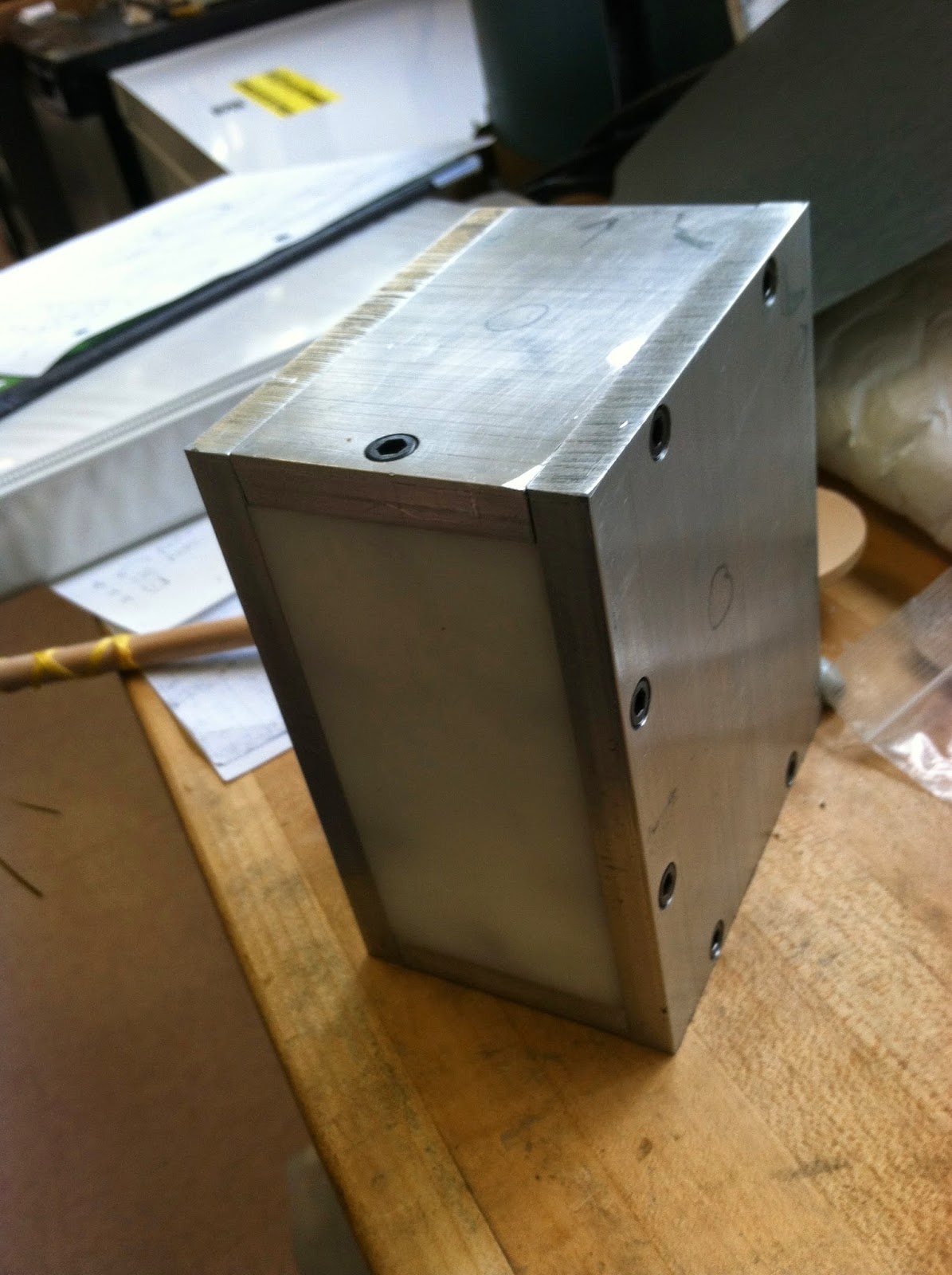
New development in the lab: the ice rig is not the only "baby" I'm working on! Trying to get as much done before my maternity leave, here I am--very pregnant--machining an ice fabrication box.
The box has stainless steel sides but a teflon bottom, so that we can undo the screws and push the ice sample and teflon out of the can.
The top plate of the can has two ports: one for a vacuum and one to flood the sample with zero degree water. Beneath the top plate is a layer of teflon with a square o-ring that fits snuggly into the the top of the can. Fine-grained seed ice is packed into the can and then the lid pushes down and packs it more firmly while a vacuum pulls out excess air. Cooled water is then flooded into the pore space and freezes into a fully dense sample. All of this is done in a cold room that we now have access to.


Thursday, 25 April 2013

Ice rig frame is assembled

Once we finally got the aluminum plates back from the machine shop, it was all hands on deck to assemble the ice rig frame. Here Hannah and I tighten the unistrut base and assemble the frame.
Next came the tie rods, middle supporting beams and the top aluminum plate. Had to make sure everything was level and lubed up.
 A little while later, undergrad lab assistant Ben attached homemade brass bolts to which we will attach side plates (which the horizontal ram will need to push off of). He's hammering the top plate to get it in just the right position.


Saturday, 26 January 2013

changing a gasket

So we've been suspecting for awhile that the vertical hydraulic piston on the biax might be leaking. Now that Nicholas has arrived to really start plugging away on some experiments, it became apparent that it needed fixing. Ted figured that we needed to change a gasket, which is no small feat. This week Ted and Nicholas slung a pulley system over a beam in the ceiling and carefully lifted out the cylinder.
 Inside that big yellow cylinder lives a whole series of concentric rings that fit together to form the seal. Ted and Nicholas inspected them all carefully. Most of them were all still in great shape, despite some forty odd years of usage. But one piece in particular was torn to shreds. They replaced the part, lugged the cylinder back up and reattached it to the biax frame.
 
Next thing on the docket is improving the hydraulic system on the vertical ram. Nicholas wants to add a reservoir system so that he can very quickly add and decrease the normal stress. Currently we only have a little hand crank. To be continued...