Wednesday, 18 June 2014
Newest lab member
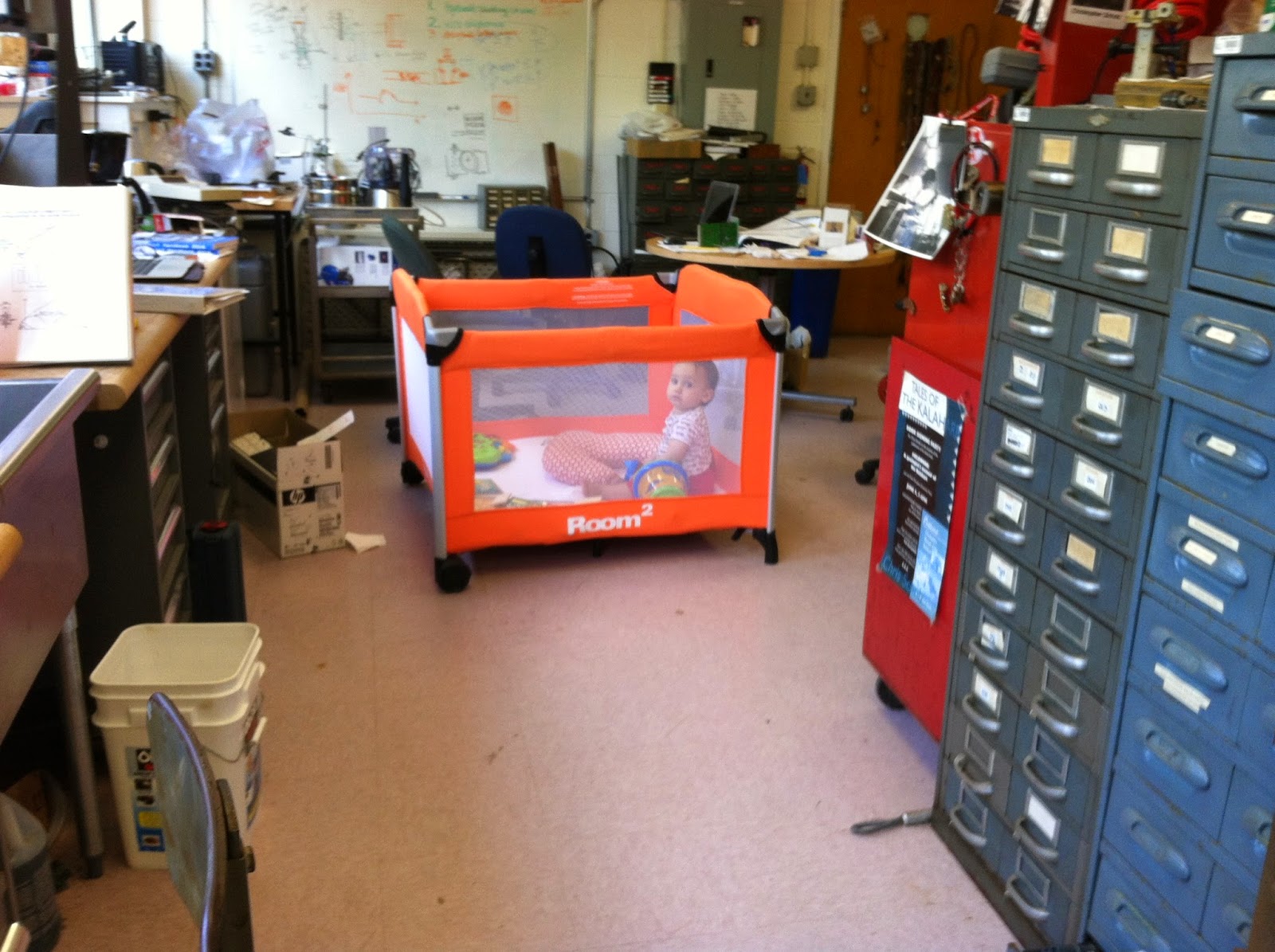
Upon returning from Japan it is a race against the clock to catch as much time with Ted as possible before he heads out for his summer holiday. Although I usually work from home on Tuesdays (and thus don't have daycare), I can't waste a single day. So Elenore gets to come along and hang out with me in the lab. Usually she can't stand being in the playpen, but I think she got the sense that it was safer in there than out on the lab floor. She happily played while Mom soldered and Ted designed more electronic schematics.

Thursday, 5 June 2014
Presses and baby presses
One of the aspects of my research in Takei-san's lab is grain growth of prepared sample via annealing (that is, placing the sample in an incubator). When I was previously working in the lab, we found that during annealing, grain growth caused porosit. Although the porosity did not affect our attenuation measurements, it did cause scatter in the modulus data, so is not ideal. After I left, they developed a method for keeping confining pressure on the sample while it incubated for weeks at a time. They also slowly ramp up the temperature so that the grain growth is not too rapid. The method for applying the pressure is this spring press. A spring is tightened by screwing down with an allen wrench so that it loads the piston from above. Since the sample is held in the die, it cannot deform and the stress confines the sample. It worked wonderfully.

They have a few of these prepared so that multiple samples can anneal at a time. Also, since our protocol involves making a small companion, or "baby" sample, on which we perform microstructural examinations, a small, baby press was also made. It is scaled so that its spring applies the same corresponding stress to the smaller diameter sample. Uchida-san machined that baby press while I was there so it was very fun for us. It was pretty cute. Why am I bringing this up? Well another fun thing that occurred during my trip was a birthday of a lab mate. Birthdays are a special treat because we are privileged to see some of Yamauchi-san's artwork. Below is the awesome birthday card she drew to celebrate Suzuki-san's birthday. Note the spring presses and that my baby Elenore is holding the new baby spring press.

Tuesday, 3 June 2014
A machine shop to aspire to...
One of the many things that I love about working at ERI is Uchida-san's machine shop. It is a masterpiece. Every single thing is in its right place…


...and is sparkling. I don't understand how he can get a lathe that shiny. Ours is covered with a film of oil and dust that is decades old. I asked him what he uses, thinking there was some magical cleaner only available in Japan. He laughed and said that he just used a clean cloth, but that he cleaned the whole lathe right after using it, every single time he uses it.
Even something so insignificant as sandpaper is ordered and labeled by grit size and the cutting tool is right there. Ours are thrown haphazardly in a single drawer.
So all of this has got me thinking that we may need an Extreme Machine Shop Makeover as well.
Stay tuned.
Thursday, 29 May 2014
Research trip to Tokyo
This spring I went back to Takei-san's lab in Tokyo to conduct an intensive research project that sort of piggybacks onto our previous work together. In our previous studies, we looked at the effects of grain size, temperature, and melt on viscosity and attenuation. Now we are hoping to explore the effect of prior deformation, particularly by dislocation creep. In theory, dislocations (generated during deformation) should provide additional dissipation and therefore higher attenuation. We would like to quantify that effect. But the first step is to better understand the flow law for the organic analogue that we use. So we performed creep experiments in the Instron apparatus below. A cell with circulating water maintains the temperature (the sample is safe and dry inside a double plastic film) and even provides a small confining pressure.

Ultimately they will test pre-deformed samples in the attenuation apparatus below, which has had so many improvements since I was a postdoc here (2.5 y ago). Because they have a salaried machinist that is shared with only a few researchers they are able to make iterations on the rig very rapidly. It's really a great machine!

I brought my daughter and my mother with me to Japan for the two months. While I worked in the lab during the day, they strolled around Tokyo visiting nearby zoos and parks. Below we celebrated Mother's day by going out of town to a nearby Ryokan (traditional Japanese style hotel).

And since we were there in the spring, we participated in many Hanami celebrations, which are picnics to honor the cherry blossom trees. If you're interested, more about Hanami here and here (from when we lived here full-time).

Thursday, 16 January 2014
While I was away...
Although I was out on maternity leave for six months, the project did not sit dormant. I came back to big improvements to the ice rig. Ted installed all of the hydraulics (pipes running behind the rig, connecting to the two rams), including the servo amp electronics (green panel on front).


Check out the insane soldering work done by Heather on this Limits board.

Even more on the back side.

Thursday, 21 November 2013


Thursday, 23 May 2013
a bun in the oven; a sample in the freezer

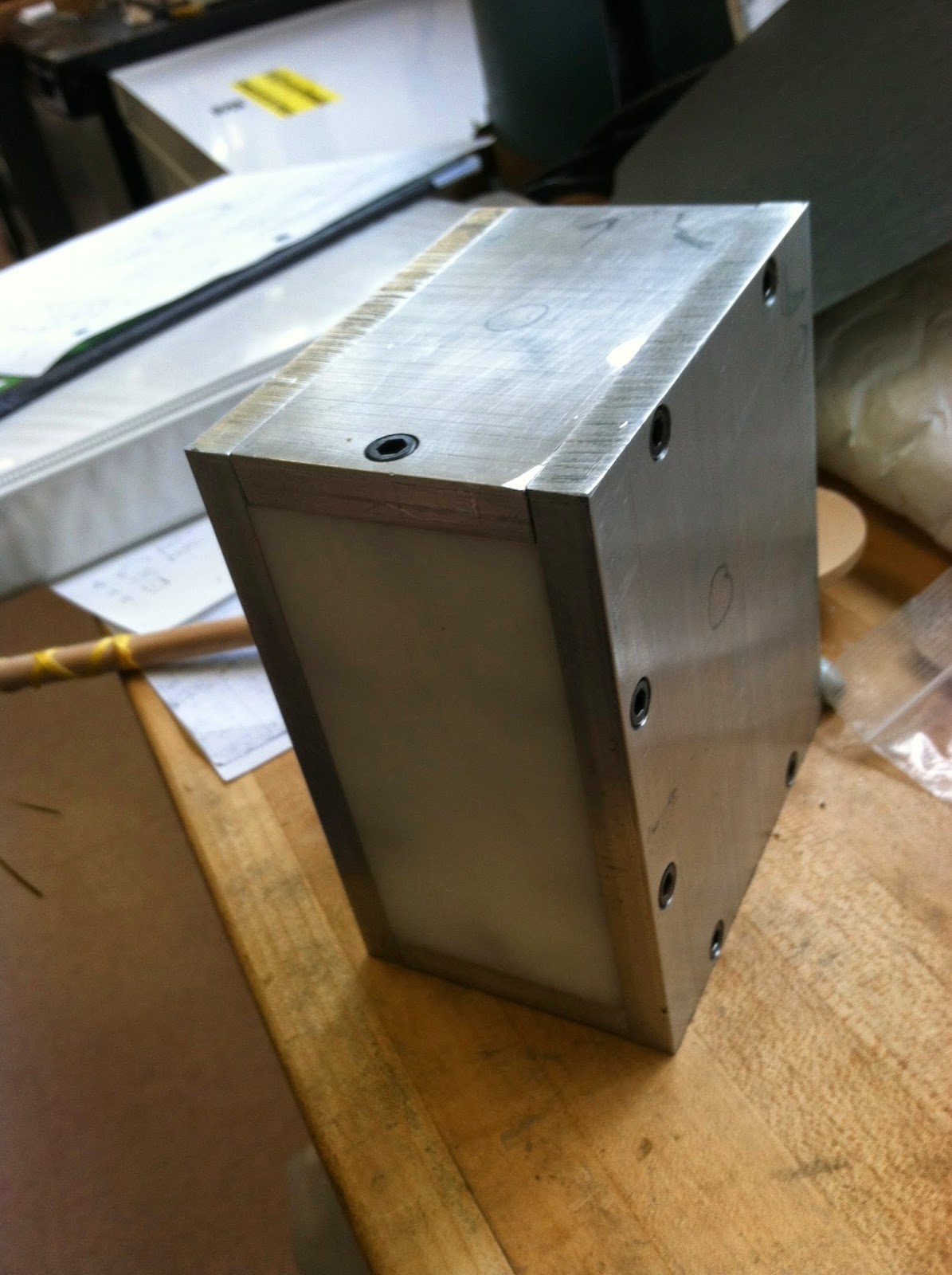
The box has stainless steel sides but a teflon bottom, so that we can undo the screws and push the ice sample and teflon out of the can.

Subscribe to:
Posts (Atom)