text

The rock and ice mechanics lab at Lamont-Doherty is led by PIs Christine McCarthy and Ben Holtzman. Now, more than ever, we are in the process of growing our lab and building our experimental program. Along with a team of postdocs, undergrads, grads, techs, and longtime staff engineer Ted, we are rehabilitating and revamping some of the old equipment and building and buying new rigs for exciting new experiments on both rock and ice. You can follow along with our progress here.

Monday, 1 September 2014

Field trip to Italy

by Hannah Rabinowitz


This summer, Heather and I had the opportunity to go to the Istituto Nazionale di Geofisica e Vulcanologia (INGV) in Rome.  In addition to spending a lot of time making our way through the gelaterias of Rome, we were able to run a couple of series of experiments on two different deformation apparatuses in the rock mechanics lab there.


Taste-testing gelato at a gelateria recommended by Kevin Uno

The apparatuses we used this summer in Rome.  SHIVA is on the left and BRAVA on the right.

One set of these experiments was conducted with Giulio di Toro and Elena Spagnuolo on the Slow to HIgh Velocity Apparatus (SHIVA).  SHIVA is a high velocity rotary shear apparatus that can slide either intact rocks or gouge layers at high velocity and high normal stress.  This is actually the apparatus that first got me interested in rock mechanics research.  After seeing a video of one of the first SHIVA tests in which solid rock samples were sheared to form pseudotachylite (frictional melt) during a class in undergrad, I went straight to my professor’s office to ask to work in his lab.  Though I did experiments on a different deformation apparatus for my undergraduate research (a Griggs rig), I was lucky enough to get to go use SHIVA with my undergrad advisor the summer before starting at Lamont.  So in a way, I’ll always feel I owe more to this apparatus than just the cool results that it can give us!  But really, who could watch this video and not fall in love with rock mechanics?

In our experiments this summer on SHIVA, we sheared gouge at high velocity to induce frictional heating.  The goal of these experiments is to expand the kinetics of biomarker thermal maturity to shorter timescales than is achievable in our hydrous pyrolysis apparatus at Lamont.  We also conducted slow velocity shearing experiments to test the impact of shear without significant heating on biomarker thermal maturity.  This will be important when using biomarker thermal maturity to estimate temperature rise on faults.  If shear strain can have similar effects to heating on biomarker maturity, then these effects must both be considered when we try to determine the size of the earthquake that could have produced a biomarker anomaly.  However, if the shear strain does not impact biomarker maturity significantly, then we can be more confident that a signal in the biomarker record is recording an earthquake. 

Heather prepping a sample of Woodford Shale to run on SHIVA.

Our second set of experiments were conducted with Cristiano Collettini and Brett Carpenter on the Brittle Rock deformAtion Versatile Apparatus (BRAVA), a new biaxial deformation apparatus with which we could control pore fluid pressure as well as confining pressure.  In this set of experiments, we deformed samples of sediments that are being fed into subduction zones.  We chose samples from two subduction zones in order to have a range of different carbonate content in our experiments and address the question of how compositional heterogeneity can affect the different seismic character of subduction zones.

We were fortunate to finish our planned experiments with plenty of time to spare.  Because of this, we were able to go out into the field and collect samples from a couple of faults in the Apennines.  Specifically we got to sample the Monte Maggio (a normal fault) and Spoleto (a thrust fault).  These faults were completely spectacular and we were able to drill samples from both of the fault surfaces as well as several off fault samples to use for the biomarker paleoseismic indicator project.

Drill holes from our samples on the razor sharp contact between the footwall Scaglia group red limestones and the hanging wall cataclasites at the Spoleto fault.


Heather and Brett sampling the Monte Maggio fault.  Our hosts were amused by our commitment to wearing purple gloves in the field.

Heather and I in front of the Monte Maggio slip surface.

Saturday, 16 August 2014

Soldering Superstar

Undergraduate student Zach helped us out in the lab this summer. Throughout the summer he finalized the protocol for making standard ice for the ice projects, he broke up and prepped rocks for Heather's fault heating work, he helped me better organize the ice rig room and the machine shop, but where he really kicked butt was at soldering. He was a soldering maniac! He single-handedly did all of the backside connectors.
 And he also got in there with some of the fine-detailed soldering on the individual boards. 
Thanks to Zach's hard work this summer we made incredible progress on several fronts. Thanks, Zach!

Wednesday, 18 June 2014

Newest lab member

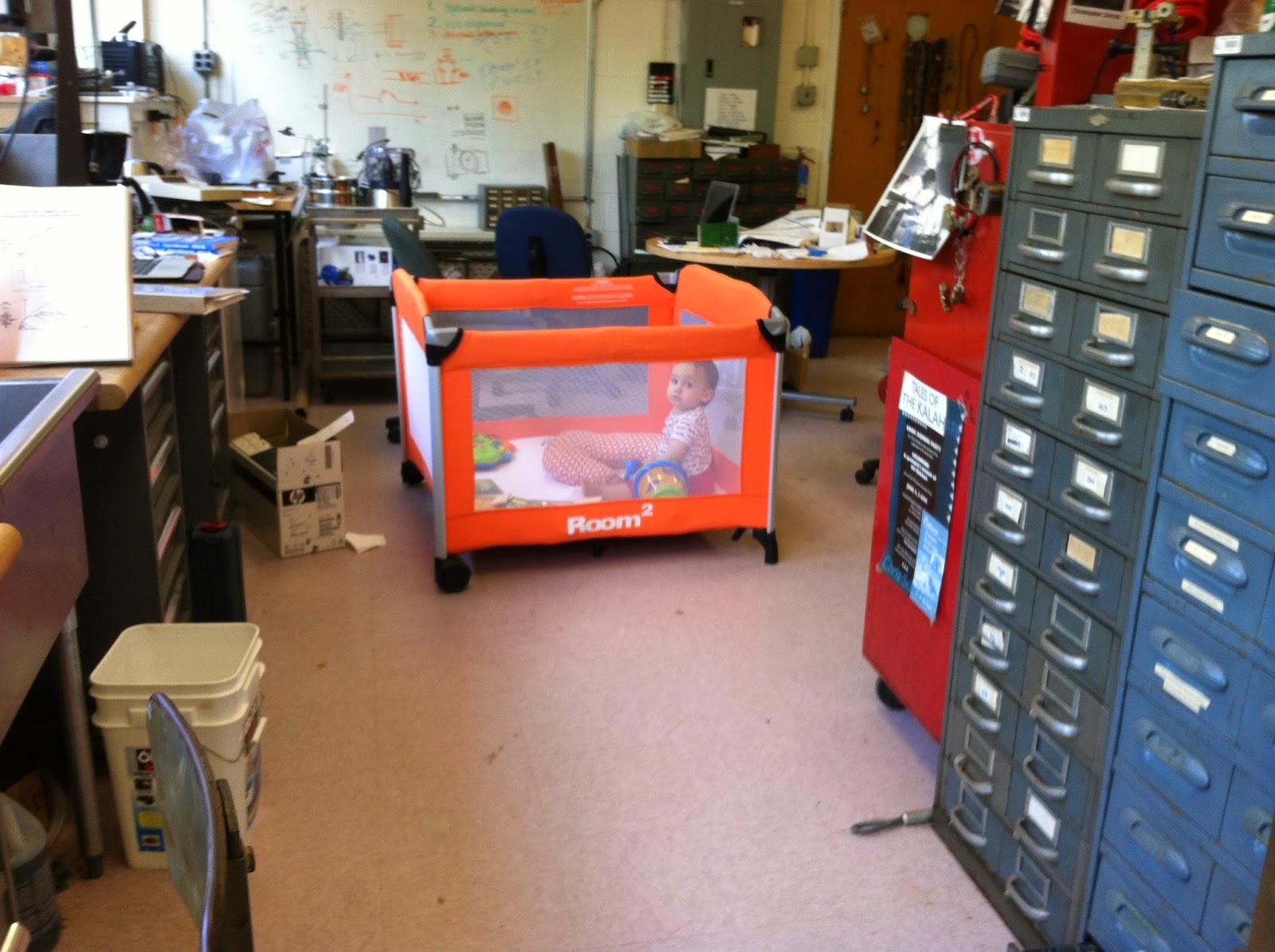
Upon returning from Japan it is a race against the clock to catch as much time with Ted as possible before he heads out for his summer holiday. Although I usually work from home on Tuesdays (and thus don't have daycare), I can't waste a single day. So Elenore gets to come along and hang out with me in the lab. Usually she can't stand being in the playpen, but I think she got the sense that it was safer in there than out on the lab floor. She happily played while Mom soldered and Ted designed more electronic schematics.

Thursday, 5 June 2014

Presses and baby presses

One of the aspects of my research in Takei-san's lab is grain growth of prepared sample via annealing (that is, placing the sample in an incubator). When I was previously working in the lab, we found that during annealing, grain growth caused porosit. Although the porosity did not affect our attenuation measurements, it did cause scatter in the modulus data, so is not ideal. After I left, they developed a method for keeping confining pressure on the sample while it incubated for weeks at a time. They also slowly ramp up the temperature so that the grain growth is not too rapid. The method for applying the pressure is this spring press. A spring is tightened by screwing down with an allen wrench so that it loads the piston from above. Since the sample is held in the die, it cannot deform and the stress confines the sample. It worked wonderfully.  
They have a few of these prepared so that multiple samples can anneal at a time. Also, since our protocol involves making a small companion, or "baby" sample, on which we perform microstructural examinations, a small, baby press was also made. It is scaled so that its spring applies the same corresponding stress to the smaller diameter sample. Uchida-san machined that baby press while I was there so it was very fun for us. It was pretty cute. Why am I bringing this up?  Well another fun thing that occurred during my trip was a birthday of a lab mate. Birthdays are a special treat because we are privileged to see some of Yamauchi-san's artwork. Below is the awesome birthday card she drew to celebrate Suzuki-san's birthday. Note the spring presses and that my baby Elenore is holding the new baby spring press.


Tuesday, 3 June 2014

A machine shop to aspire to...

One of the many things that I love about working at ERI is Uchida-san's machine shop. It is a masterpiece. Every single thing is in its right place…

...and is sparkling. I don't understand how he can get a lathe that shiny. Ours is covered with a film of oil and dust that is decades old. I asked him what he uses, thinking there was some magical cleaner only available in Japan. He laughed and said that he just used a clean cloth, but that he cleaned the whole lathe right after using it, every single time he uses it.
Even something so insignificant as sandpaper is ordered and labeled by grit size and the cutting tool is right there. Ours are thrown haphazardly in a single drawer. 
So all of this has got me thinking that we may need an Extreme Machine Shop Makeover as well. 
Stay tuned.