
Tuesday, 18 April 2017
Hanami 2017
The weather actually cooperated this year for our annual hanami party. In previous years we were not so lucky. We spread out our blue tarp and shared our treats under the bloom of the cherry blossom trees.


Thursday, 1 December 2016
Cryostat 2.0
Our original cryostat for the friction rig was awesome. We made lots of improvements to the way that temperature is monitored (with RTDs now, which have much less error) and in the insulation, etc. We started using a protocol of placing the rocks and metal at the desired testing temperature in a chest freezer over night before we start an experiment. So we've got it to where we can load a sample, give it an hour or two to really level out to a steady temperature, and then we can just let it run for hours to days of testing at constant T. Using that cryostat, we ran our first series of experiments on the temperature dependence of ice on rock friction, which was written up in this paper.
However, the lowest temperature it could achieve was about -20 deg C, determined by the chiller that circulates methanol+water through cooling blocks on the side of the cryostat. That's completely fine for terrestrial applications, but we want to also test planetary ice. So we need to go colder. Much much colder! That's why Mike has begun working on Cryostat 2.0. This cryostat will instead use methanol cooled by liquid nitrogen to flow through copper coils directly adjacent to the sample. The plus-shaped sample housing sits on top of stiff, insulating material.

It sits inside a box that will be insulated by creating a vacuum. More to come!

Tuesday, 1 November 2016


Sunday, 30 October 2016
Open House 2016
For this year's open house we went with a whole new format. Instead of cramming people into our little lab, we took up a space in one of the big tents. Here Mike talks about friction and uses our sliding blocks with different grit sandpaper to demonstrate roughness.


Here Ted talks to the folks outside the window and demonstrates all of the components that go into a friction experiment.

Tuesday, 1 December 2015
Success!
After the dry run was complete, it was time to move on to the real thing: ice-on-rock. Mike made a plexiglass front to the cryostat so we could watch what was happening and still keep things moderately cold (also thanks to our friends burlap and bubble wrap). Here it is in its "double direct shear" starting position...


...and afterward. We successfully slid ice past rock with an applied normal load (~100kPa)

A toast of champagne to celebrate!

And a paper describing the apparatus is found here.
Monday, 30 November 2015
Lab Field Trip 2015
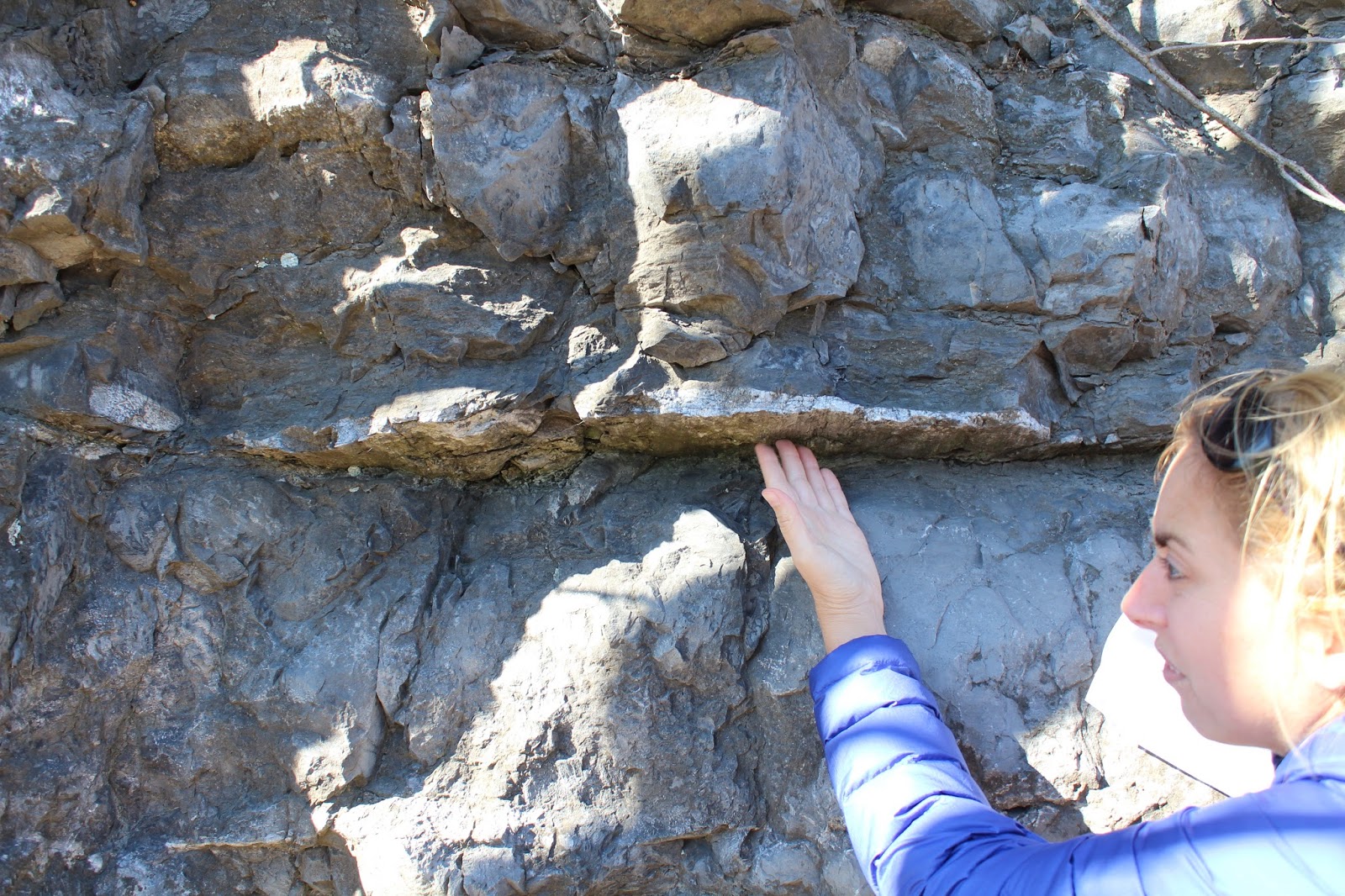
Every year the rock mechanics lab tries to sneak off for one last trip to the field before the snow arrives. This year Mike and Heather put together a plan that brought us up north a bit to the Kingston area. In particular there was a nice fault zone right off the side of the road.


 Previous cores had been taken from this fault.




Our second stop was a park overlooking the Hudson, where we ate lunch.

I was particularly excited by the chalk marks, wishing I had some gear with me.


Third stop was this eery mining cave.


Then another place with quartz crystals growing from the veins in the rock.


Final stop was this fault along a river.


Tuesday, 13 October 2015
International Glaciological Society
Last month I renewed my IGS membership and found out I was the 1100th member for 2015! I won a shirt, which I modeled here next to the ice rig. You too can join the International Glaciological Society here.


Subscribe to:
Posts (Atom)