text

The rock and ice mechanics lab at Lamont-Doherty is led by PIs Christine McCarthy and Ben Holtzman. Now, more than ever, we are in the process of growing our lab and building our experimental program. Along with a team of postdocs, undergrads, grads, techs, and longtime staff engineer Ted, we are rehabilitating and revamping some of the old equipment and building and buying new rigs for exciting new experiments on both rock and ice. You can follow along with our progress here.

Sunday, 30 October 2016

Open House 2016

For this year's open house we went with a whole new format. Instead of cramming people into our little lab, we took up a space in one of the big tents. Here Mike talks about friction and uses our sliding blocks with different grit sandpaper to demonstrate roughness.
 Meanwhile, Rob mans the elastic properties booth, where we've got a piece of rock wired up with strain gauges. He asks guests to test their strength at squeezing a rock. This year we added a rubber cube as a reference and even went with a digital display (fancy!).

Additionally we opened up the back window of the lab where the cryofriction rig is housed and allowed people to "Step Right Up" and peer in to see an actual experiment in action.
Here Ted talks to the folks outside the window and demonstrates all of the components that go into a friction experiment.


Tuesday, 1 December 2015

Success!

After the dry run was complete, it was time to move on to the real thing: ice-on-rock. Mike made a plexiglass front to the cryostat so we could watch what was happening and still keep things moderately cold (also thanks to our friends burlap and bubble wrap). Here it is in its "double direct shear" starting position...
...and afterward. We successfully slid ice past rock with an applied normal load (~100kPa)
A toast of champagne to celebrate!
And a paper describing the apparatus is found here.

Monday, 30 November 2015

Lab Field Trip 2015

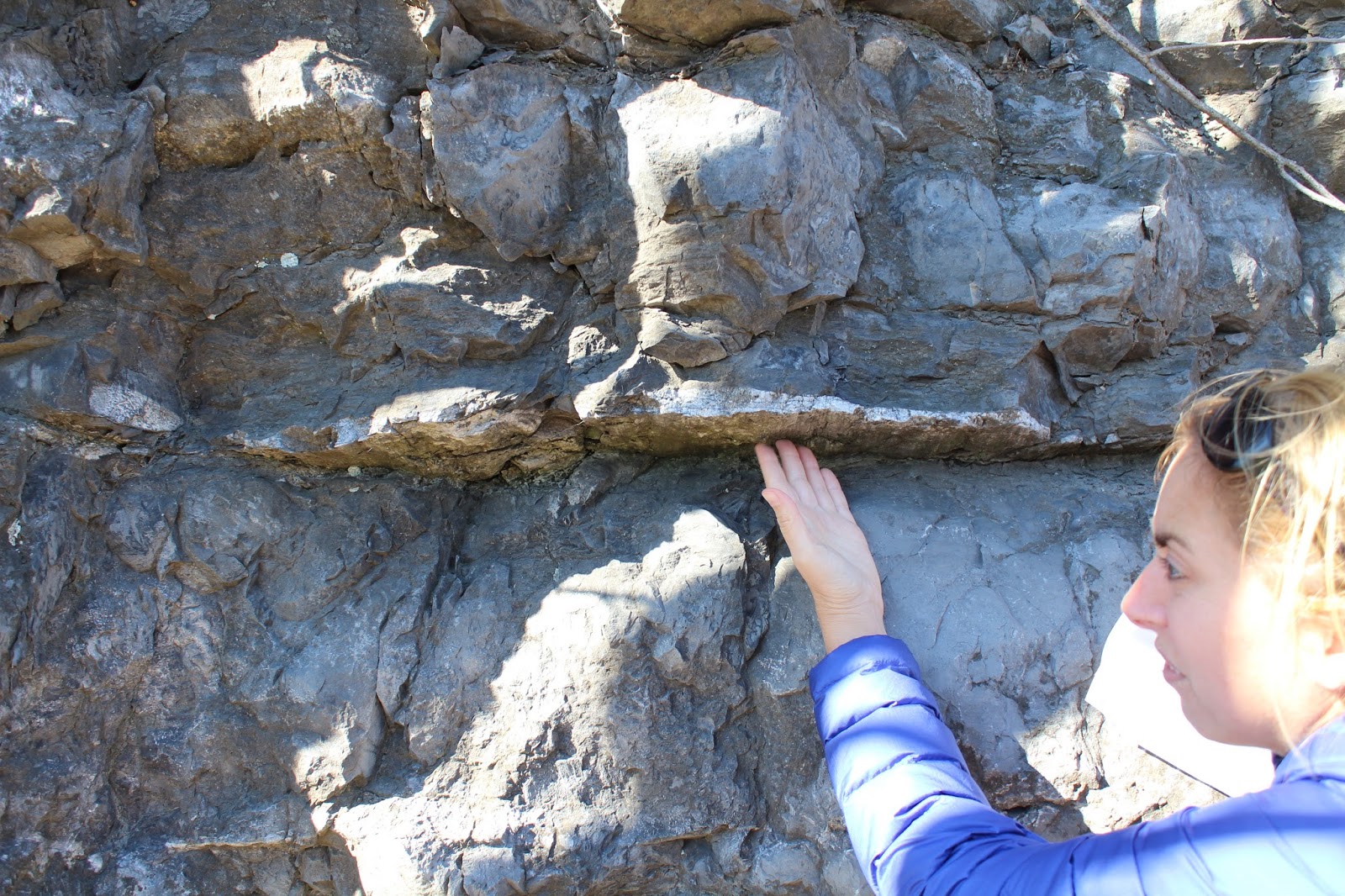
Every year the rock mechanics lab tries to sneak off for one last trip to the field before the snow arrives. This year Mike and Heather put together a plan that brought us up north a bit to the Kingston area. In particular there was a nice fault zone right off the side of the road.


Our second stop was a park overlooking the Hudson, where we ate lunch.

I was particularly excited by the chalk marks, wishing I had some gear with me.


Third stop was this eery mining cave.


Then another place with quartz crystals growing from the veins in the rock.


Final stop was this fault along a river.

 Previous cores had been taken from this fault.


Tuesday, 13 October 2015

International Glaciological Society

Last month I renewed my IGS membership and found out I was the 1100th member for 2015! I won a shirt, which I modeled here next to the ice rig. You too can join the International Glaciological Society here.

Thursday, 24 September 2015

A dry run

Before we start getting crazy with ice and cold, we want to have a dry run of the apparatus. Can we actually control it the way we want? We loaded everything up in the cryostat, but left it at room temperature with the front panel off and, instead of ice, we placed a piece of PVC plastic as our central slider.

We used some makeshift plastic pistons so as not to potentially harm our expensive ceramic ones.
We manually dialed in our horizontal piston until we got a decent normal load (the panels that say 0.167 and 0.160 are in MPa and are the right and left load cells, respectively).
Then we slowly drove the plastic down through the rock. Plastic is pretty slippery, so we didn't get to very high shear stresses, which made me very happy for a first run. It all worked in a nice controlled manner, with data sent to a computer for later analysis.  No major glitches, so next step: ICE!!


Saturday, 19 September 2015

A little nip and tuck

Now that the rig has been placed in its permanent position and the unistrut table has been bolted down to the concrete pier, it's time to address the elephant in the room. Let's talk about that rat's nest of wires.
Yeah I'm talking about you.
First thing we did was to systematically tackle each wire and cut it to the length it needed to be.
Then all the gray component wires (those going to the LVDTs and Load Cells) were tucked into this plastic housing and attached to the back edge of the lower plate. (That the channel housing is the same thickness as the plate was rather satisfying).
Then the wires coming out were wrapped in fancy black plastic. We are talking next level organization here.
Isn't this the tidiest thing you've ever seen?
No need to stop there. The chiller hoses needed to also make a clean profile. 
They carry a methanol/water mixture from the programmable chiller in the next room to the cryostat.
Looking good!